|
|
giải đáp
|
tìm các giới hạn
|
|
|
|
d)
$\mathop {\lim }\limits_{x \to m}\frac{x-m}{x^4-m^4}=\mathop {\lim }\limits_{x \to m}\frac{x-m}{(x-m)(x^3+x^2m+xm^2+m^3)}$
$=\mathop {\lim }\limits_{x \to m}\frac{1}{x^3+x^2m+xm^2+m^3}=\frac{1}{4m^3}$
|
|
|
|
giải đáp
|
tìm các giới hạn
|
|
|
|
c)
$\mathop {\lim }\limits_{x \to m} \frac{x^3-m^3}{x-m}= \mathop {\lim }\limits_{x \to m} \frac{(x-m)(x^2+xm+m^2)}{x-m} $
$=\lim_{x\to m} (x^2+xm+m^2)=3m^2$
|
|
|
|
giải đáp
|
tìm các giới hạn
|
|
|
|
b)
$\mathop {\lim }\limits_{a \to 0}\frac{2(x+a)^3-2x^3}{a}=2\mathop {\lim }\limits_{a \to 0}\frac{3x^2a+3xa^2+a^3}{a} $
$=2\lim_{a\to0}(3x^2+3xa+a^2)=6x^2$
|
|
|
|
giải đáp
|
tìm các giới hạn
|
|
|
|
a)
$\mathop {\lim }\limits_{a \to 0}\frac{(x+a)^2-x^2}{a}= \mathop {\lim }\limits_{a \to 0}\frac{2ax+a^2}{a} $
$=\mathop{\lim}\limits_{a\to0}(2x+a)=2x$
|
|
|
|
giải đáp
|
Làm bài hình cho đỡ khô khan
|
|
|
|
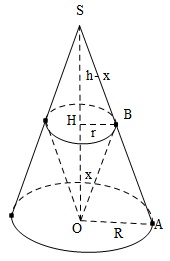 Gọi $r$ là bán kính đáy của $(C), V$ là thể tích hình nón đỉnh $O$ đáy là hình tròn $(C)$, ta có: $\frac{r}{R}=\frac{SH}{SO}=\frac{h-x}{h} \Rightarrow r=\frac{(h-x)R}{h}$ $\Rightarrow V=\frac{1}{3}\pi r^2.x=\frac{1}{3} \pi.\frac{R^2}{h^2}(h-x)^2 x=\frac{\pi R^2}{6h^2}(h-x)^2.2x$ Áp dụng bất đẳng thức Cô-si cho $3$ số $2x,h-x,h-x$ ta được $2h=h-x+h-x+2x \geq 3\sqrt[3]{(h-x)^2.2x}$ Dấu "=" xảy ra khi $x=\frac{h}{3}$ Khi đó $V=\frac{\pi R^2}{6h^2}(h-x)^2 \leq \frac{\pi R^2}{6h^2}.\frac{8h^3}{27}=\frac{4\pi R^2h}{81}$ Vậy khi $x=\frac{h}{3}$ thì thể tích $V$ đạt giá trị lớn nhất ($\max V=\frac{4\pi R^2h}{81}$) |
|
|
|
giải đáp
|
Giúp em với các bác ơi
|
|
|
|
e)$e^{2x}+e^{-2x}+2=\left (e^{x}+e^{-x} \right )^{2} $
$\Rightarrow \int\limits \sqrt{e^{2x}+e^{-2x}+2}dx=\int\limits\left ( e^x+e^{-x} \right ) dx= e^x-e^{-x}+C $
|
|
|
|
giải đáp
|
Giúp em với các bác ơi
|
|
|
|
a) $ \frac{1+e^{3x}}{1+e^{x}}=1-e^{x}+e^{2x}$
$\Rightarrow \int\limits \frac{1+e^{3x}}{1+e^x}dx $
$ =\int\limits (1-e^x+e^{2x})dx$
$= x-e^x+\frac{1}{2}e^{2x}+C $
|
|
|
|
giải đáp
|
Giúp em với các bác ơi
|
|
|
|
d)$\left ( \cot x-\tan x \right )^{2}=\cot ^{2}x+\tan ^{2}x-2=\left ( 1+\cot ^{2}x\right )+\left ( 1+\tan ^{2}x\right )-4 $
$\Rightarrow \int\limits\left (\cot x-\tan x \right )^2dx = \int\limits \left[ { \left ( 1+ \cot ^2x \right ) + \left ( 1+\tan ^2x \right )-4 } \right]dx $
$=- \int\limits d \left ( \cot x \right )+ \int\limits d (\tan x) - \int\limits 4 dx$
$=- \cot x+\tan x-4x+C$
|
|
|
|
giải đáp
|
Giúp em với các bác ơi
|
|
|
|
c)
$ \frac{x^{4}}{x^{2}-1}=\frac{\left ( x^{4}-1 \right )+1}{x^{2}-1}=x^{2}+1+\frac{1}{2}\left ( \frac{1}{x-1}-\frac{1}{x+1} \right )$
$\Rightarrow \int\limits \frac{x^4}{x^2-1}dx = \int\limits \left[ {x^2+1+\frac{1}{2} \left ( \frac{1}{x-1} -\frac{1}{x+1} \right ) } \right] dx$
$=\frac{x^3}{3}+x+\frac{1}{2} \ln |\frac{x-1}{x+1} | +C $
|
|
|
|
giải đáp
|
Giúp em với các bác ơi
|
|
|
|
b)$ \frac{1}{3x^2-2}=\frac{1}{3}.\frac{1}{x^{2}-\frac{2}{3}}=\frac{1}{2\sqrt{6}}\left ( \frac{1}{x-\sqrt{\frac{2}{3}}}-\frac{1}{x+\sqrt{\frac{2}{3}}} \right )$
$\Rightarrow \int\limits \frac{dx}{3x^2-2}=\frac{1}{2 \sqrt{6} } \int\limits \left[ {\frac{1}{x- \sqrt{\frac{2}{3} } }- \frac{1}{x+ \sqrt{\frac{2}{3} } }} \right]dx$
$= \frac{1}{2 \sqrt{6} } \ln |\frac{x- \sqrt{\frac{2}{3} } }{x+ \sqrt{\frac{2}{3} } } |+C$
$=\frac{1}{2 \sqrt{6} }\ln |\frac{\sqrt{3}x-\sqrt{2}}{\sqrt{3}x+\sqrt{2}}|+C$
|
|
|
|
giải đáp
|
Giúp em với các bác ơi
|
|
|
|
a)$ \tan ^{8}x=\left (\tan ^{8}x+\tan ^{6}x \right )-\left ( \tan ^{6}x+\tan ^{4}x \right )+\left ( \tan ^{4}x+\tan ^{2}x \right )-\left ( \tan ^{2}x+1 \right )+1$
$ =\tan ^{6}x\left ( \tan ^{2}x+1 \right )-\tan ^{4}x\left ( \tan ^{2}x+1 \right )+\tan ^{2}x\left ( \tan ^{2}x+1 \right )-\left ( \tan ^{2}x+1 \right )+1$
$=\tan ^{6}x\left ( \tan x \right )^{'}-\tan ^{4}x\left ( \tan x \right )^{'}+\tan ^{2}x\left ( \tan x \right )^{'}-\left ( \tan x \right )^{'}+1$
$\Rightarrow \int\limits \tan ^8xdx=\int\limits \left ( \tan ^6x-\tan ^4x+\tan ^2x-1 \right ) d(\tan x)+ \int\limits dx$
$= \frac{\tan ^7x}{7}- \frac{\tan ^5x}{5}+\frac{\tan ^3x}{3}-\tan x+C $
|
|
|
|
giải đáp
|
em có bài này giúp e với
|
|
|
|
Ta có: $1+\frac{1}{\cos 2x}=\frac{1+\cos 2x}{\cos 2x}=\frac{2\cos^2 x}{\cos 2x}$ $=\frac{\cos^2 x.\sin 2x}{2\cos 2x.\sin x.\cos x}=\frac{\tan 2x}{\tan x}$ với $x \neq \frac{\pi}{2} (2)$ Gọi $P_k=1+\frac{1}{\cos 2^k a}, k=0,1,2...,n$ ta có: $P_n=P_0.P_1....P_n=\frac{\tan a}{\tan \frac{a}{2} }.\frac{\tan 2a}{\tan a}.\frac{\tan 2^2a}{\tan 2^{n-1}a}=\frac{\tan 2^n a}{\tan \frac{a}{2} }$ Vậy $P_n=\frac{\tan 2^n a}{\tan \frac{a}{2} }$ |
|
|
|
giải đáp
|
giúp e với
|
|
|
|
Đẳng thức có thể cho có thể viết: $r_m=r_n+r_q+r=\frac{S}{p-m}+\frac{S}{p-n}+\frac{S}{p-q}+\frac{S}{p}$ hay $\frac{1}{p-m}-\frac{1}{p}=\frac{1}{p-n}+\frac{1}{p-q} \Leftrightarrow \frac{m}{p(p-m)}=\frac{p-q+p-n}{(p-n)(p-q)}$ tức là : $(q+m-n)(m+n-q)=(m+n+q)(n+q-m)$ hay $m^2=n^2+p^2$ Vậy $\Delta MNQ$ vuông tại M |
|
|
|
giải đáp
|
giải giúp mình nhé mọi người
|
|
|
|
Ta có: $\begin{cases}x^3+4y=y^3+16x\\1+y^2=5(1+x^2)\end{cases} $
$\Leftrightarrow \left\{ \begin{array}{l} x^3-y^3=4(4x-y)\\y^2-5x^2=4 \end{array} \right.$
$\Leftrightarrow \left\{ \begin{array}{l} y^2-5x^2=4\\ x^3-y^3=(y^2-5x^2)(4x-y) \end{array} \right.$
$\Leftrightarrow \left\{ \begin{array}{l} y^2-5x^2=4\\ 21x^3-5x^2y-4xy^2=0 \end{array} \right.$
$\Leftrightarrow \left\{ \begin{array}{l} y^2-5x^2=4\\ x(7x-4y)(3x+y)=0 \end{array} \right.$
*) Với $x=0$, suy ra: $y=\pm2$
*) Với $7x-4y=0$, suy ra: $-\frac{31}{16}x^2=4$, vô nghiệm.
*) Với $3x+y=0$, suy ra: $(x,y)\in\{(1,-3),(-1,3)\}$
|
|
|
|
giải đáp
|
mệnh đề
|
|
|
|
Các mệnh đề sai: a, b
Các mệnh đề đúng: c, d, e, f.
|
|